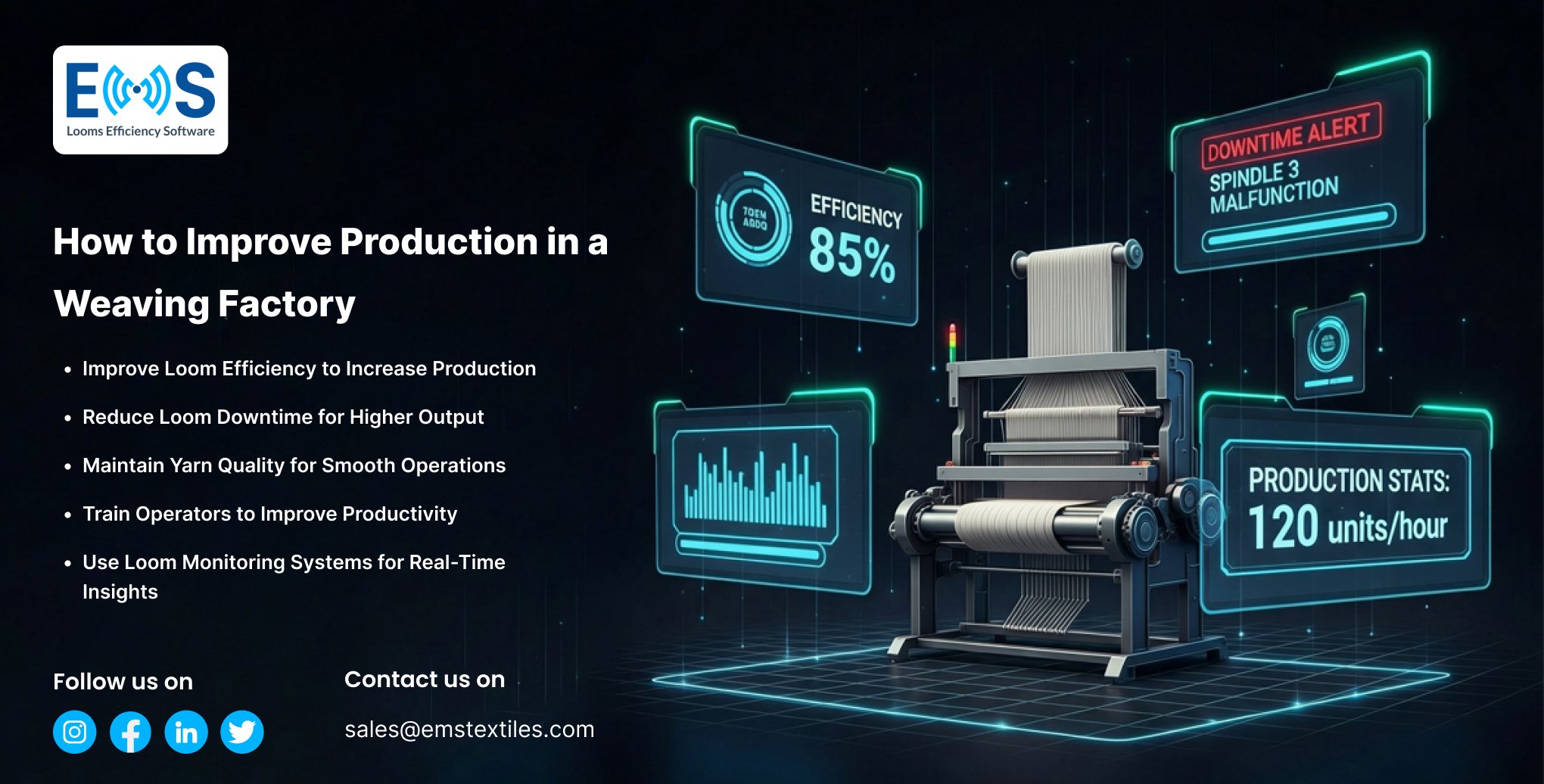
How to Improve Production in a Weaving Factory
Introduction:
Production efficiency is vital for any weaving factory. In today’s competitive textile market, factory owners seek ways to boost weaving factory production, cut operational losses, and increase profits.
Many textile mills face issues like low loom efficiency, frequent machine stoppages, yarn breakage, and poor production monitoring. Even minor losses across many looms can greatly impact output.
The good news? You don’t always need more machines to improve production. Often, you can improve output by focusing on loom efficiency, reducing downtime, and upgrading monitoring systems.
Common Production Problems in Weaving Factories
Understanding common issues is key to improving production in textile mills.
1. Low Loom Efficiency: Low loom efficiency is a frequent challenge in weaving factories. When machines don’t run smoothly or stop often, production drops.
Causes of low loom efficiency include:
- Poor machine maintenance
- Incorrect machine settings
- Yarn breakage
- Operator errors
A drop in loom efficiency directly affects weaving-factory production.
2. Frequent Loom Downtime: Another major issue is loom downtime. Stoppages can result from warp breakage, weft issues, mechanical problems, or slow operator responses.
Frequent stoppages during a shift lead to lost production time. Even a few minutes per machine can cause significant losses across the factory.
Reducing downtime is one of the best ways to improve textile mill productivity.
3. Lack of Production Monitoring: Many traditional weaving factories still use manual records, making it hard to track real-time machine performance.
Without proper monitoring, factory managers may struggle with:
- Identifying poor-performing looms
- Locating machine stoppages
- Understanding which shifts produce less output
This lack of visibility often lowers the efficiency of the loom and production.
Practical Ways to Improve Weaving Factory Production
Improving production requires better machine management, skilled operators, and modern monitoring systems.
1. Improve Loom Efficiency: Boosting loom efficiency should be a top goal for any weaving factory.
You can achieve this by:
- Performing regular machine maintenance
- Frequently checking machine settings.
- Ensuring good yarn quality
- Monitoring machine performance daily
When looms run smoothly, weaving factory production naturally increases. Even small improvements can lead to bigger gains.
2. Reduce Loom Downtime: Cutting machine stoppages is crucial for boosting production.
Factories can reduce downtime by:
- Identifying the main stoppage causes
- Quickly fixing mechanical issues.
- Training operators to respond faster
- Keeping spare parts available
Less downtime means longer machine operation and improved textile mill productivity.
3. Maintain Yarn Quality: Yarn quality is essential for weaving performance. Poor quality can lead to warp breakage and weft issues.
To ensure steady production, factories should:
- Inspect yarn before use.
- Maintain proper warp tension.
- Ensure appropriate storage
Better yarn quality lowers breakage and improves loom efficiency.
4. Train Machine Operators: Operators play a crucial role in weaving factories. Skilled operators can spot problems early and fix minor issues before they escalate.
Regular training helps operators:
- Understand machine behaviour
- Respond quickly to stoppages
- Maintain fabric quality
When operators work effectively, weaving factory production improves.
Example of Production Improvement
Take a weaving factory with 200 looms in daily operation. If the average loom efficiency is 80%, a lot of potential production is lost. Even a small improvement, such as increasing efficiency from 80% to 90%, can significantly boost production without investing in new machines.
This improvement may result from:
- Reducing loom downtime
- Improving yarn handling
- Monitoring machine performance closely
Such changes directly improve textile mill productivity.
How Loom Monitoring Systems Help Textile Mills
Modern textile factories are adopting loom monitoring systems to track real-time production performance.
A loom monitoring system collects data from weaving machines, providing insights like the following:
- Loom efficiency
- Machine status
- Causes of stoppage
- Production per loom
With this data, managers can quickly address issues affecting weaving factory production. For instance, if a loom frequently stops, the problem can be fixed right away.
Monitoring systems help factories
- Improve loom efficiency
- Reduce downtime
- Increase textile mill productivity.
Many weaving units now use digital monitoring to optimise production and improve performance.
Conclusion
Improving production in a weaving factory requires a combination of better machine management, skilled operators, and effective monitoring systems.
Key factors that influence weaving factory production include the following:
- improving loom efficiency
- reducing loom downtime
- maintaining yarn quality
- training machine operators
- using production monitoring tools
When these practices are implemented consistently, textile mills can significantly improve textile mill productivity without large investments.
In today’s competitive textile industry, factories that focus on efficient machine management and real-time production monitoring will always have an advantage.