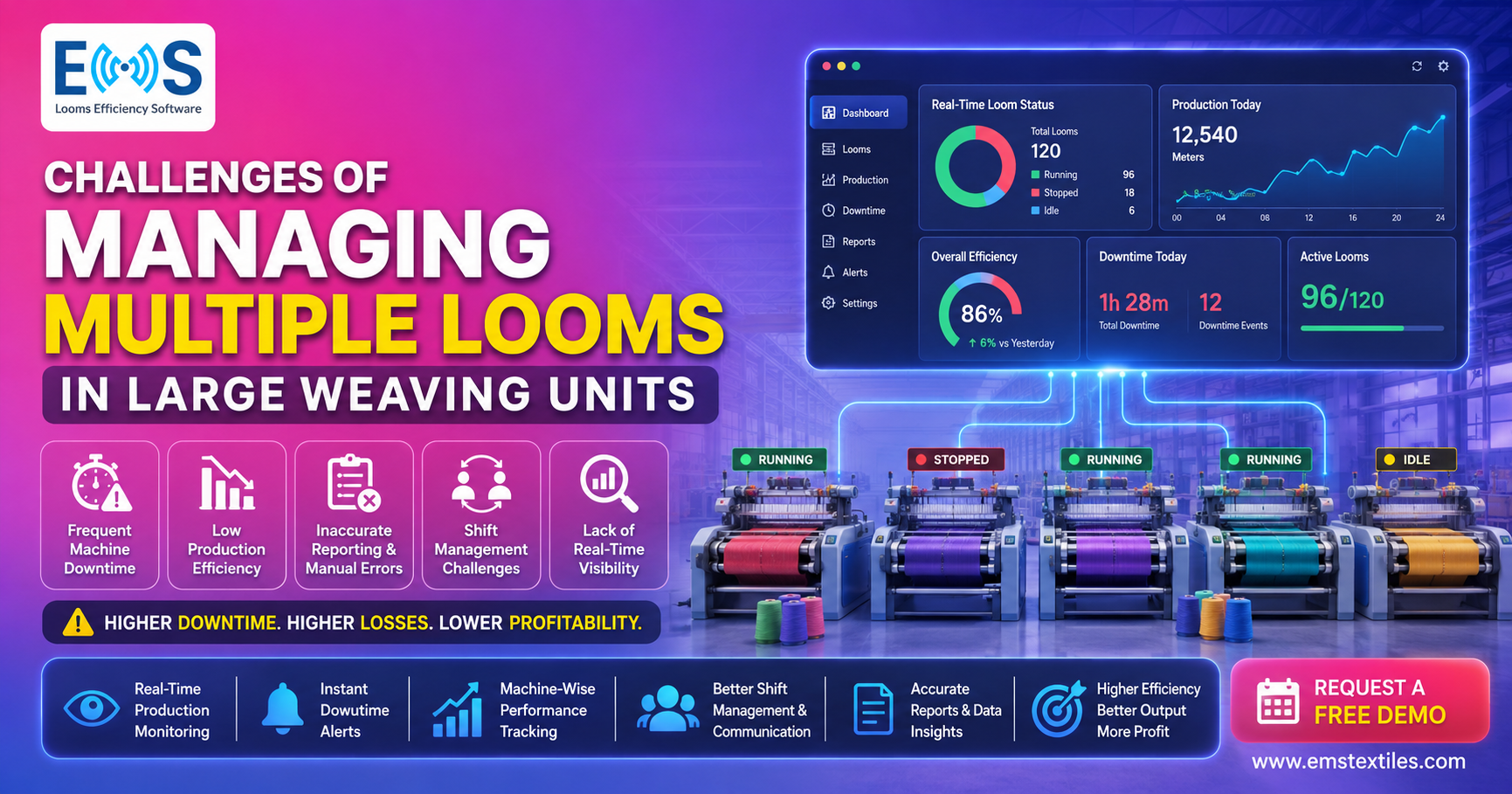
Challenges of Managing Multiple Looms in Large Weaving Units
The textile industry is becoming more competitive every year. Today, weaving factory owners are expected to increase production, reduce downtime, improve efficiency, and deliver quality fabric on time. However, managing multiple looms in a large weaving unit is not an easy task.
Many textile mills still depend on manual production tracking, supervisor-based reporting, and physical monitoring of machines. While this method may work in smaller factories, it becomes difficult when dozens or hundreds of looms are running together.
In large weaving units, even a small issue in one machine can affect overall production, delivery timelines, and factory profitability. This is why many textile mills are now adopting loom monitoring software and real-time textile production monitoring systems to improve factory management.
In this blog, we will discuss the major challenges of managing multiple looms in weaving factories and how EMS helps solve these operational problems.
1. Difficulty in Tracking Real-Time Production
One of the biggest challenges in large weaving factories is tracking live production across all machines.
In many mills, supervisors collect production data manually through registers, phone calls, or verbal updates from operators. This process consumes time and often leads to inaccurate reporting.
When multiple looms are operating together, factory owners cannot physically monitor every machine throughout the day. Because of this, problems like low production, machine stoppages, or efficiency drops may go unnoticed for several hours.
Without real-time loom monitoring, factory owners usually receive production reports only after a shift ends. By then, production losses may already have occurred.
Using a textile production monitoring system helps factory owners track:
- Running machines
- Stopped looms
- Production status
- Shift-wise performance
- Machine-wise efficiency
- Production targets
Live production visibility helps management teams take faster decisions and improve factory operations.
2. Machine Downtime Often Goes Unnoticed
Machine downtime is one of the most common reasons for production loss in textile mills.
Looms may stop because of:
- Yarn breakage
- Operator absence
- Mechanical faults
- Beam changes
- Power issues
- Quality problems
In large weaving units, supervisors may not immediately notice which machine has stopped and for how long.
Even short periods of unnoticed downtime can create major production losses by the end of the day.
For example, if multiple looms remain idle for 20–30 minutes without attention, total production output can reduce significantly.
This is why real-time downtime monitoring is important for modern weaving factories.
3. Managing Operators Across Multiple Shifts
Most large textile factories operate in multiple shifts. Managing operators efficiently across all shifts is another major challenge.
Common problems include:
- Shift handover confusion
- Delayed issue reporting
- Lack of communication
- Incomplete machine updates
- Operator dependency
Sometimes machine issues from one shift are not properly communicated to the next shift. As a result, production problems continue for longer periods.
Manual communication methods also increase reporting errors and confusion between supervisors and operators.
Without proper monitoring, factory owners struggle to maintain operational consistency across shifts.
4. Difficulty in Identifying Low-Performing Machines
In every weaving factory, some machines perform better than others.
Certain looms may continuously produce lower output because of:
- Maintenance issues
- Old machine parts
- Improper settings
- Operator handling problems
However, identifying low-performing machines manually is very difficult in large weaving units.
Many factory owners only discover these problems after reviewing monthly production reports or facing delivery delays.
Without machine-wise performance tracking, production optimization becomes difficult.
5. Lack of Accurate Production Data
Accurate production data is extremely important for textile factory planning and customer commitments.
However, many factories still depend on manual production entries. This creates problems such as:
- Incorrect production reports
- Missing data
- Human errors
- Delayed updates
- Production mismatches
When management teams do not receive reliable production data, decision-making becomes slower and less accurate.
For example:
- Yarn planning may become inaccurate
- Delivery commitments become risky
- Production targets may not be achieved properly
Digital textile production monitoring systems help solve these issues by collecting data automatically from machines in real time.
6. Managing Different Types of Looms Together
Many weaving factories operate different types of looms together, such as:
- Airjet looms
- Waterjet looms
- Rapier looms
- Shuttle looms
Each loom type has different production speed, maintenance requirements, and operational behavior.
Managing all these machines manually becomes complicated, especially in large weaving units.
Without centralized monitoring, comparing machine performance and identifying operational issues becomes difficult.
7. Delayed Decision-Making
In the textile industry, delayed decisions directly affect production efficiency and profitability.
When factory owners depend completely on manual updates from supervisors, important information often reaches management too late.
For example:
- Machine stoppages may not be reported immediately
- Production targets may be missed
- Quality issues may continue unnoticed
- Maintenance problems may increase
Without live production visibility, management teams cannot respond quickly to operational issues.
This affects overall factory performance.
8. Difficulty in Monitoring Multiple Factory Floors
Some weaving units operate across multiple factory floors or production sections.
In such cases, additional operational challenges arise:
- Supervisors cannot continuously monitor every section
- Communication gaps increase
- Production tracking becomes slower
- Issue escalation takes more time
Physically checking each department multiple times a day is not practical in large textile factories.
Factory owners need centralized visibility to manage operations more efficiently.
9. Increased Dependency on Manual Supervision
In many textile mills, production management depends heavily on supervisors.
However, manual supervision has limitations:
- One supervisor cannot monitor every machine continuously
- Human errors are common
- Reporting quality depends on individuals
- Production tracking may become inconsistent
As weaving units expand, depending completely on manual supervision becomes difficult.
Factories need smarter systems that provide automated production visibility and machine monitoring.
10. Production Planning Becomes More Complicated
Production planning is one of the most important parts of textile manufacturing.
However, planning becomes difficult when factories manage multiple looms without live production data.
Common challenges include:
- Unplanned downtime
- Inaccurate production estimates
- Delayed reporting
- Machine performance variation
- Delivery planning issues
Without accurate production tracking, factories often react to problems after losses have already occurred.
Better production planning requires accurate live machine data and real-time visibility.
How EMS Helps Textile Mills Manage Multiple Looms Efficiently
EMS is designed to help textile factory owners manage multiple looms more efficiently through real-time production monitoring and centralized factory visibility.
In large weaving units, manually tracking every machine becomes difficult. EMS solves this challenge by providing live production data, machine status updates, and instant alerts from a single dashboard.
With EMS, factory owners can monitor:
- Running and stopped looms
- Machine-wise production
- Shift-wise performance
- Loom efficiency
- Idle machine time
- Production reports
- Operator-related production data
EMS allows management teams to access factory data from:
- Mobile devices
- PCs
- Smart TVs
This helps factory owners stay connected with production even when they are not physically present on the factory floor.
Real-Time Downtime Alerts with EMS
One of the biggest advantages of EMS is instant downtime detection.
If any loom stops because of yarn breakage, machine faults, or operator-related issues, EMS immediately updates the machine status on the dashboard.
This helps supervisors:
- Identify stopped machines faster
- Reduce idle time
- Respond quickly to production issues
- Improve loom utilization
As a result, textile mills can reduce production losses significantly.
Better Production Visibility with EMS
Many textile mills struggle because production updates are delayed or manually recorded.
EMS eliminates this issue by automatically collecting production data directly from machines in real time.
Factory owners get better visibility into:
- Total production
- Machine performance
- Shift efficiency
- Production targets
- Operational status
With accurate live data, management teams can make faster and more informed decisions.
Centralized Monitoring for Multiple Looms
Managing multiple looms across different departments becomes easier with EMS.
Instead of depending entirely on manual supervision, factory owners can monitor all machines from one centralized dashboard.
This improves:
- Factory visibility
- Operational control
- Communication between shifts
- Reporting accuracy
Centralized monitoring also helps reduce confusion in large weaving units.
Improved Factory Efficiency with EMS
By reducing downtime, improving reporting accuracy, and increasing production visibility, EMS helps textile mills improve operational efficiency.
Factories can:
- Reduce idle machine time
- Improve loom utilization
- Increase production consistency
- Improve shift coordination
- Reduce manual reporting errors
EMS helps weaving factories modernize operations and improve production management through real-time monitoring and smarter factory control.
Conclusion
Managing multiple looms in a large weaving unit is becoming increasingly challenging for textile factory owners. Manual monitoring methods are no longer sufficient for factories that want better production control, higher efficiency, and reduced operational losses.
Challenges such as machine downtime, inaccurate reporting, delayed communication, operator dependency, and lack of production visibility can directly affect factory profitability and operational performance.
This is why many textile mills are now adopting loom monitoring software and real-time textile production monitoring systems like EMS.
EMS helps textile factories monitor machine performance, reduce downtime, improve production visibility, and manage multiple looms more efficiently from a centralized platform.
As the textile industry continues moving toward automation and digital factory management, real-time monitoring solutions like EMS are becoming an important part of modern weaving factory operations.
Ready to see EMS in action? Request a free demo today and discover how easy it is to manage every loom in your factory from one powerful dashboard.