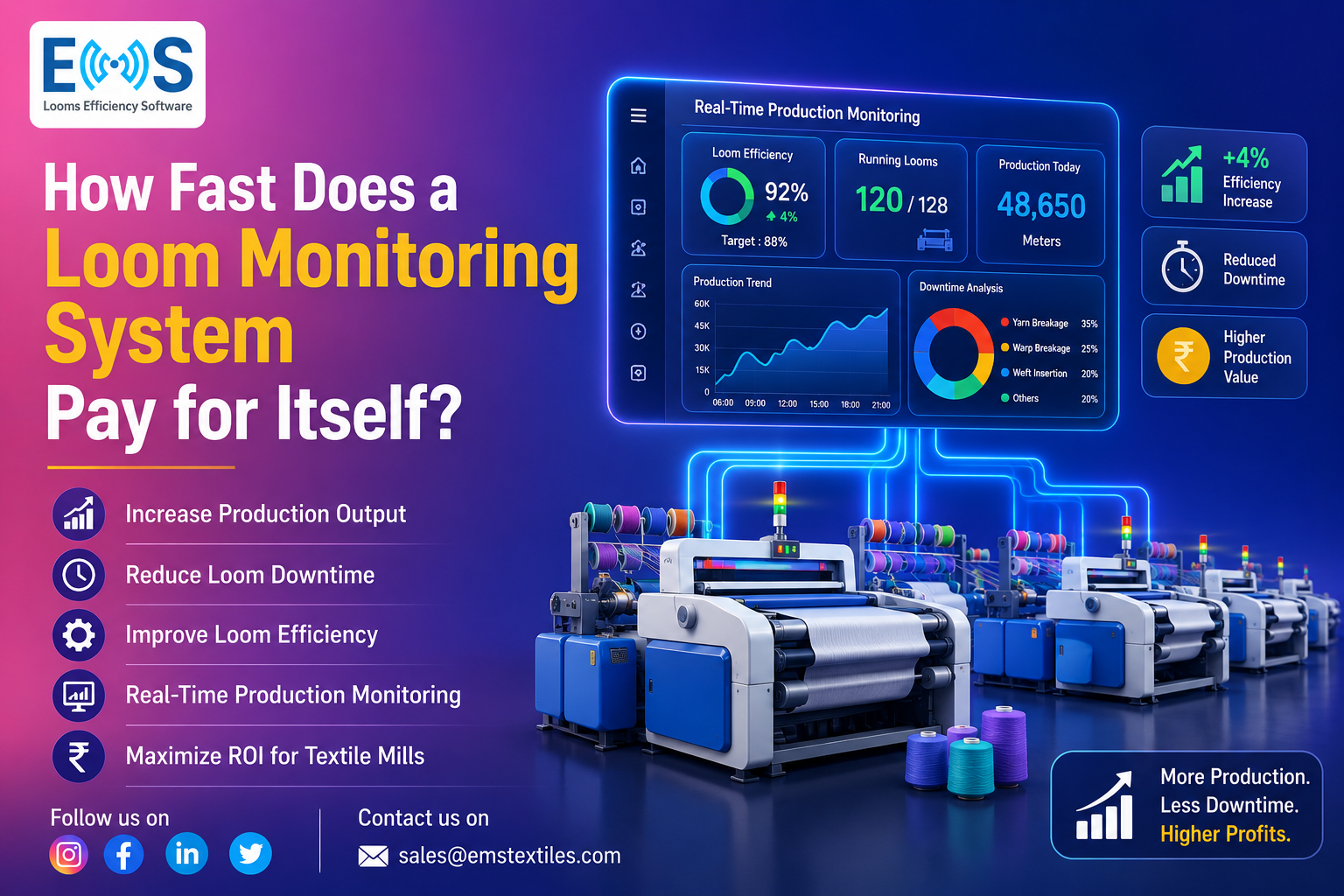
ROI of Loom Monitoring System: How Quickly Can a Textile Mill Recover Its Investment?
Every textile mill owner wants to improve production, reduce downtime, and increase profits. However, when it comes to investing in new technology, one question always comes first:
“Will this loom monitoring system really pay off?”
It’s a fair question especially in today’s competitive weaving industry where every rupee matters. Many mill owners hear about production monitoring software, understand how real-time monitoring can help, but still wonder if the investment is actually worth it.
Here’s the reality: If you’re running a textile mill, a good loom monitoring system or textile production monitoring system often pays for itself much faster than you might expect. And these savings don’t just look good on paper, they show up in your daily numbers and your peace of mind.
Let’s break down what ROI really means for weaving mills, where those savings come from, and how quickly you can expect to see your investment paid back.
What Is a Loom Monitoring System?
Think about the last time you tried to get a clear picture of what was happening on your weaving floor. If you’re still using manual reports or walking the floor to count meters, you know how tough it is to get accurate answers fast.
A loom monitoring system (LMS) changes that. With real-time production monitoring, you can instantly see:
- Loom efficiency for every machine
- Which looms are running and which are stopped
- Details about machine stoppages and downtime
- Accurate production output – no guesswork
- Shift and operator performance
- Automatic downtime reports
A good production monitoring software does more than just collect data – it helps you make smarter decisions, cut losses, and run your mill like a true business.
Understanding ROI in Textile Manufacturing
ROI stands for Return on Investment.
In simple terms, ROI measures how much profit or savings an investment generates compared to its cost.
For textile mills, the gains usually come from:
- Higher production
- Reduced downtime
- Better machine utilization
- Lower maintenance costs
- Reduced manpower dependency
- Improved efficiency
The more savings generated, the faster the investment pays for itself.
Why Many Textile Mills Lose Money Without Knowing It
Most weaving mills focus only on total production.
However, many hidden losses occur every day:
Small Machine Stops
A loom stops for 5 minutes.
No one notices.
Production is lost.
Delayed Response Time
Operators may take several minutes to restart machines.
Unrecorded Downtime
Manual reports often fail to capture every stoppage.
Poor Visibility
Managers discover problems only after the shift ends.
These small losses seem insignificant individually but become substantial over time.
The Hidden Cost of Loom Downtime
Let’s look at a simple example.
Suppose a weaving unit has:
- 100 looms
- Average downtime of 20 minutes per loom daily
Total lost time:
100 × 20 = 2,000 minutes per day
That equals:
33.3 hours of production are lost daily.
Over a month, the loss becomes enormous.
Most factory owners are surprised when they calculate the actual impact.
This is where a Loom Monitoring System creates value.
How a Loom Monitoring System Improves ROI
1. Reduces Machine Downtime
Real-time monitoring immediately alerts supervisors when a machine stops.
Instead of finding out hours later, action can be taken instantly.
Benefits include:
- Faster response time
- Reduced idle periods
- Increased production
Even a small reduction in downtime can generate significant savings.
2. Improves Loom Efficiency
Many weaving mills operate at lower efficiency than expected.
Without accurate data, identifying underperforming looms becomes difficult.
A loom monitoring system helps management:
- Identify low-performing machines
- Analyze downtime causes
- Improve machine utilization
An efficiency increase of even 3–5% can significantly impact overall production.
3. Increases Production Output
Higher machine uptime leads directly to increased production.
For example:
A factory producing 50,000 meters per day may gain additional production simply by reducing avoidable stoppages.
Since fixed costs remain largely unchanged, additional production improves profitability.
4. Reduces Dependence on Manual Reporting
Many mills still rely on supervisors collecting production data manually.
Problems include:
- Human error
- Delayed reporting
- Inaccurate information
A textile production monitoring system automates data collection and reporting.
Management receives accurate information without manual effort.
5. Better Maintenance Planning
Frequent machine breakdowns increase maintenance expenses.
Monitoring systems help identify:
- Frequently failing looms
- Breakdown trends
- Maintenance requirements
This supports preventive maintenance and reduces emergency repairs.
Example ROI Calculation for a Textile Mill
Let’s consider a practical example.
Factory Details
- 120 Looms
- Average Efficiency: 82%
- Monthly Production Value: ₹1 Crore
After implementing a Loom Monitoring System:
- Efficiency improves to 86%
- Downtime reduces
- Production increases
Production Improvement
Efficiency increase:
86% – 82% = 4%
Production gain:
₹1 Crore × 4%
= ₹4 Lakhs additional value per month
Suppose the annual cost of the monitoring system is ₹3 Lakhs.
Additional monthly value:
₹4 Lakhs
Annual gain:
₹48 Lakhs
Even after system costs, the return is substantial.
In many cases, investment recovery occurs within a few months.
Factors That Affect ROI
Every mill is different, but these factors play a big role:
- Number of looms: The more machines, the faster the savings add up.
- Current efficiency: Lower starting efficiency = bigger improvements.
- Existing systems: If you’re using manual reporting, benefits are even greater.
- Management action: The system gives you the data – acting on it is what drives results.
Signs Your Mill Can Achieve Fast ROI
Your weaving unit is likely to benefit if:
- Production reports are manual.
- Downtime reasons are unclear.
- Machine efficiency varies widely.
- Supervisors spend time collecting data.
- Operators are not accountable for stoppages.
- Production targets are frequently missed.
These are common indicators that production visibility is limited.
Short & Long Term Benefits of a Loom Monitoring System
Within the first few months, most mills notice:
- Real-time production visibility – no more guessing
- Faster decision-making – fix problems as they happen
- Improved accountability – everyone knows where they stand
- Accurate, automated data – no more manual calculations
Longer term, you get:
- Better customer service (on-time deliveries)
- Full operational control (from anywhere)
- Data-driven management (facts, not assumptions)
- Scalability (system grows with your mill)
Common Misconceptions About Loom Monitoring Systems
“The System Is Expensive”
Many owners focus on system cost but ignore ongoing production losses.
The real question is:
How much is the factory losing every month without monitoring?
“Our Supervisors Already Monitor Production”
Manual supervision is important, but it cannot provide real-time data from every loom at every moment.
Digital monitoring complements human supervision.
“We Will Install It Later”
Delaying implementation often means continuing to lose production daily.
Every month of delay can result in avoidable losses.
How EMS Helps Textile Mills Achieve Faster ROI
EMS (Efficiency Monitoring System) provides textile mills with real-time visibility into production operations.
Through a centralized dashboard, EMS helps management:
- Monitor the loom efficiency
- Track machine downtime
- Analyze production trends
- Improve machine utilization
- Compare target vs actual production.
- Generate automatic reports
Instead of waiting for end-of-shift reports, factory owners receive actionable information instantly.
This enables faster decisions, improved productivity, and quicker return on investment.
How Quickly Can a Textile Mill Recover Its Investment?
There is no single answer because every factory is different.
However, many weaving mills recover their investment through:
- Reduced downtime
- Increased efficiency
- Higher production output
- Better resource utilization
For factories operating hundreds of looms, even a small improvement in efficiency can generate savings that far exceed the cost of the monitoring system.
The larger the factory and the greater the existing inefficiencies, the faster the recovery period is likely to be.
Conclusion
A Loom Monitoring System is no longer just a technology upgrade. It is a business tool that helps textile mills improve efficiency, reduce downtime, and increase profitability.
The biggest advantage is not simply collecting data but using that data to make better operational decisions.
When factory owners gain real-time visibility into machine performance, downtime, and production output, they can identify losses faster and take corrective action immediately.
For many weaving mills, the investment pays for itself through improved efficiency and higher production. In some cases, the recovery period may be only a few months.
The key question is no longer:
“Can I afford a Loom Monitoring System?”
It is:
“How much production am I losing every day without one?”