In the bustling textile hubs of Surat, Ahmedabad, and beyond, the hum of loom machines is the heartbeat of a thriving industry. But what if you could not just hear that heartbeat, but see its every beat, predict its every flutter, and optimize its rhythm for peak performance? This is where Digital Twin technology steps in, offering a revolutionary approach to textile manufacturing. For Indian textile owners aiming to stay competitive and lead the market, understanding and adopting Digital Twins is no longer a luxury, but a necessity.
At EMS Textiles, we understand the intricacies of loom operations and the constant pressure to enhance efficiency and reduce downtime. Digital Twin technology, when combined with robust machine monitoring, represents the next frontier in achieving these goals.
What is Digital Twin Technology for Textiles?
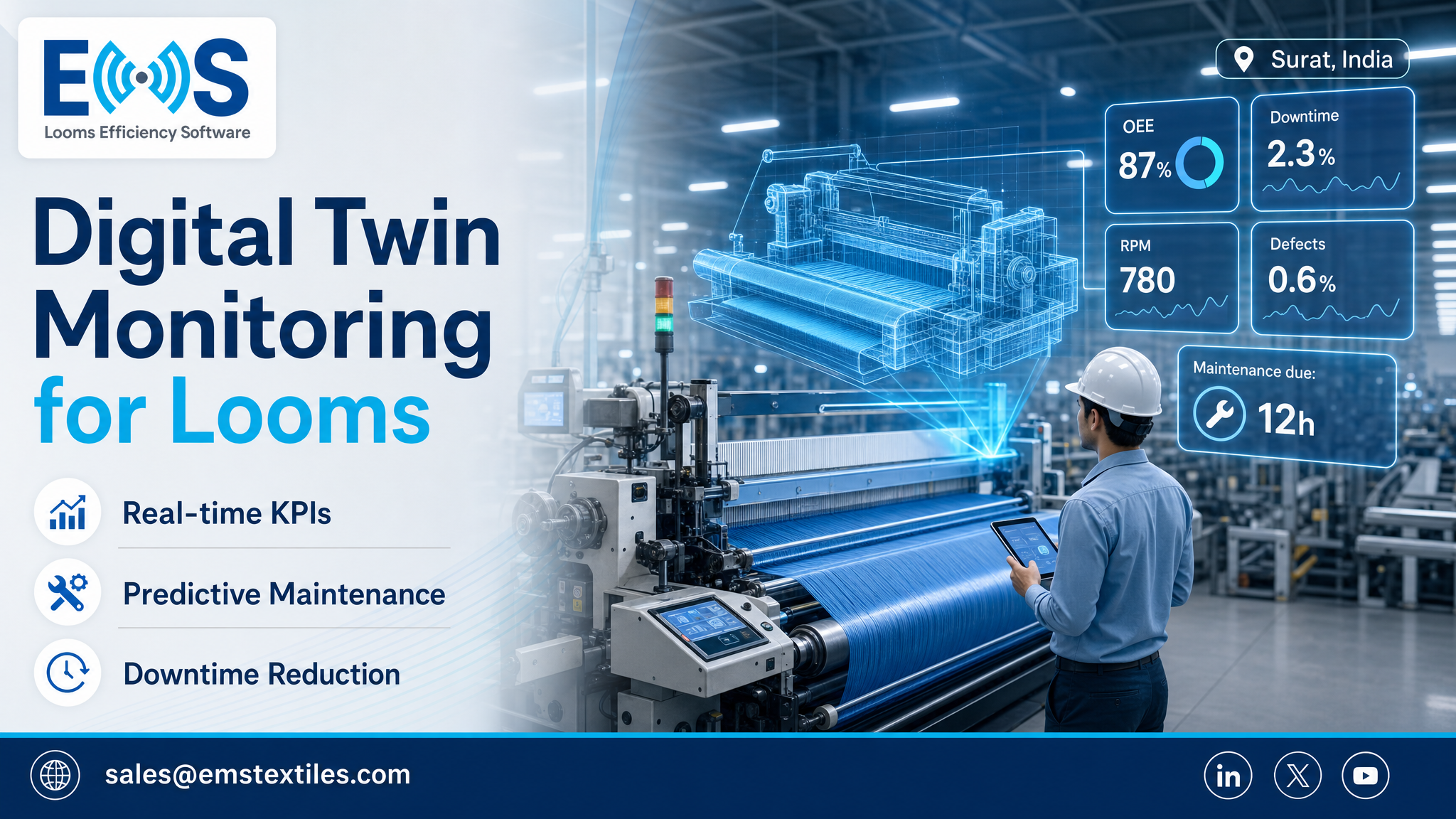
Imagine having a precise, living, breathing virtual replica of each of your physical loom machines. This is exactly what a Digital Twin is. It's a dynamic virtual model that mirrors a physical object, process, or system. In the context of textile manufacturing, a Digital Twin of a loom machine is a computer-generated duplicate that receives real-time data from its physical counterpart through sensors, machine monitoring systems, and other data sources.
This virtual twin then provides insights into the physical loom's performance, health, and potential issues. It's a two-way street: not only does the digital twin receive data, but it can also be used to simulate changes and inform actions taken on the physical machine. This continuous data exchange creates a powerful feedback loop, allowing for unprecedented levels of control and optimization.
Think of it this way: If your physical loom machine is a patient, its Digital Twin is its complete medical history, real-time vital signs monitor, and a sophisticated simulation model all rolled into one. It tells you not just what is happening, but what might happen, and how to prevent it.
How Digital Twins Revolutionize Weaving Operations
The application of Digital Twin technology extends far beyond simple monitoring. It empowers textile manufacturers to make informed, proactive decisions that drive efficiency and profitability. Here's how:
1. Performance Simulation and Optimization
- Predictive Performance: Before a new batch of yarn is even loaded, manufacturers can simulate how a loom will perform under different conditions – varying yarn types, speeds, tension settings, and environmental factors.
- Optimized Settings: The digital twin allows engineers to virtually 'test' thousands of parameter combinations to find the absolute optimal settings for specific fabric qualities, minimizing waste and maximizing output without trial-and-error on expensive physical machines.
- New Product Development: Introduce new fabric designs or yarn blends virtually, analyze their impact on machine stress and fabric quality, and fine-tune processes before committing to physical production.
2. Proactive Issue Detection and Predictive Maintenance
This is where Digital Twins truly shine in preventing costly downtime. By continuously analyzing real-time data from the physical loom, the digital twin can:
- Detect Anomalies: Identify subtle deviations in vibration, temperature, energy consumption, or motor performance that might indicate impending failure long before it becomes critical.
- Predict Component Lifespan: Based on usage patterns and stress analysis, the twin can estimate the remaining useful life of critical components like shuttles, healds, reeds, or main bearings, allowing for 'just-in-time' maintenance.
- Schedule Maintenance Smartly: Instead of fixed schedules or reactive repairs, maintenance can be planned precisely when needed, reducing unnecessary interventions and preventing unexpected breakdowns. EMS Textiles' advanced monitoring solutions provide the crucial real-time data needed to feed these digital twins effectively.
3. Enhanced Quality Control and Waste Reduction
Quality is paramount in textiles. Digital Twins contribute significantly by:
- Identifying Root Causes: When defects occur, the digital twin can help trace back the exact machine parameters, environmental conditions, or raw material inputs that contributed to the issue, enabling rapid correction.
- Optimizing Tension and Feed: Simulate the effects of different tension settings on yarn breakage and fabric quality, ensuring consistent output and reducing material waste from defects.
- Reducing Rework: By predicting and preventing quality issues, the need for costly rework and rejection of finished goods is drastically minimized.
4. Energy Efficiency and Resource Management
With rising operational costs, energy efficiency is a key concern. Digital Twins can:
- Analyze Energy Consumption: Pinpoint which processes or machine states consume the most energy, allowing for targeted optimization.
- Optimize Production Schedules: Simulate different production runs to find the most energy-efficient sequences, potentially staggering machine use to avoid peak load charges.
Implementing Digital Twins: A Practical Checklist for Textile Factories
Adopting Digital Twin technology might seem daunting, but a phased approach can make it manageable. Here's a practical checklist to guide Indian textile manufacturers:
- Assess Your Current Infrastructure: Evaluate your existing machinery, sensor capabilities, and data collection systems. Do you have adequate IoT sensors? Is your network robust enough for data transfer?
- Define Your Goals: Clearly identify what you want to achieve. Is it reducing downtime, improving quality, saving energy, or all of the above? Start with a pilot project focusing on one or two key objectives.
- Invest in Data Collection and Integration: Reliable, real-time data is the lifeblood of a Digital Twin. This means implementing or upgrading machine monitoring solutions like those offered by EMS Textiles, which capture accurate data from your looms. Ensure seamless integration with other factory systems (ERP, MES).
- Choose the Right Platform/Partner: Select a Digital Twin platform or partner that understands the nuances of textile machinery and can offer tailored solutions. Consider scalability and ease of use.
- Develop the Digital Twin Model: Work with experts to create accurate virtual models of your specific loom machines. This involves understanding mechanical, electrical, and operational characteristics.
- Validate and Refine: Compare the Digital Twin's predictions with actual physical machine performance. Continuously refine the model based on real-world data to improve its accuracy.
- Train Your Team: Ensure your operators, maintenance staff, and engineers are trained to interpret the insights provided by the Digital Twin and act upon them effectively.
- Scale Up: Once successful with a pilot, gradually expand the Digital Twin implementation across more machines and processes in your factory.
Key Benefits and ROI: Traditional vs. Digital Twin
Let's look at a comparative overview of how Digital Twin technology delivers a compelling return on investment (ROI) compared to traditional operational methods:
| Aspect | Traditional Weaving Operations | Digital Twin Powered Operations |
|---|---|---|
| Downtime | Frequent unexpected breakdowns, reactive maintenance leading to significant production losses. | Reduced by 20-50% due to predictive maintenance, proactive issue resolution. |
| Maintenance Costs | Higher costs from emergency repairs, spare parts inventory holding, and scheduled but often unnecessary maintenance. | Lowered by 10-30% through optimized scheduling, extended component life, and reduced emergency interventions. |
| Production Efficiency | Sub-optimal machine settings, trial-and-error adjustments, difficulty in identifying bottlenecks. | Increased by 5-15% through precise parameter optimization, real-time performance insights, and streamlined workflows. |
| Product Quality | Reactive defect detection, higher scrap rates, inconsistent quality across batches. | Improved by 5-20% by preventing defects, optimizing material flow, and ensuring consistent output quality. |
| Energy Consumption | Limited visibility into energy usage per machine/process, potential for wastage. | Reduced by 5-10% through optimized machine utilization and identification of energy-intensive processes. |
| Time-to-Market (New Products) | Lengthy physical prototyping and testing cycles. | Accelerated by 15-40% with virtual prototyping, simulation, and rapid process optimization. |
The Future is Here: Partnering with EMS Textiles
The journey towards a fully optimized, smart weaving factory starts with reliable data. Digital Twin technology thrives on precise, real-time information about your loom machines' performance, health, and environment. This is exactly where EMS Textiles excels. Our advanced machine monitoring software provides the granular, accurate data streams necessary to build and maintain effective Digital Twins for your looms.
By leveraging EMS solutions, you get:
- Accurate Data Collection: Our sensors and software capture every critical parameter from your machines.
- Real-time Insights: Instantly know the status, efficiency, and potential issues of your looms.
- Integration Capabilities: Our systems are designed to integrate seamlessly with advanced analytics and Digital Twin platforms, providing the foundation for your smart factory initiatives.
Embracing Digital Twin technology means moving beyond traditional reactive maintenance and guesswork. It means stepping into a future where your weaving operations are not just efficient, but intelligent, predictive, and consistently optimized. Partner with EMS Textiles to lay the foundation for your Digital Twin journey and unlock unparalleled efficiency and profitability in your textile manufacturing.
Ready to revolutionize your weaving operations with intelligent insights? Contact EMS Textiles today to learn how our machine monitoring solutions can power your Digital Twin initiatives!
Ready to Transform Your Weaving Operations?
Book a free demo and see how EMS monitoring software can power your Digital Twin journey and drive real ROI in your textile factory.
Book a Free Demo