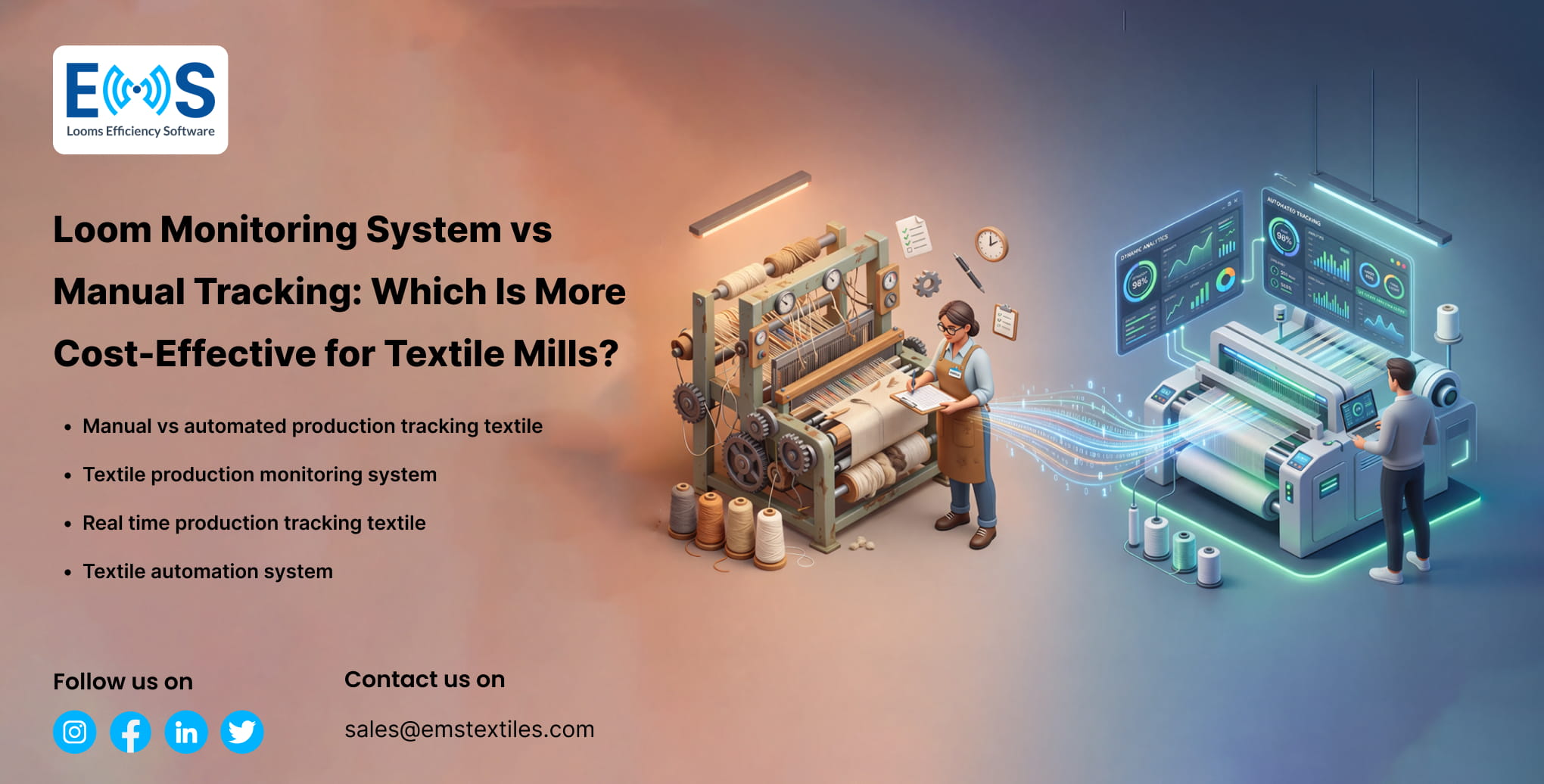
Loom Monitoring System vs Manual Tracking: Which Is More Cost-Effective for Textile Mills?
Introduction: The Cost You Don’t See Is the Cost That Hurts the Most
Walk into any weaving mill, and you’ll see a familiar scene: operators noting down production data in registers, supervisors updating Excel sheets at shift end, and managers relying on yesterday’s reports to make today’s decisions. On the surface, this manual production tracking feels simple and “free.”
But here’s the truth most mills miss:
Manual production tracking isn’t cheap – it’s just quietly expensive.
The real cost?
Missed production, late reactions, unnoticed downtime, and operator inefficiencies that quietly chip away at your profits – day after day.
Now, automated systems like a loom monitoring system or a real-time production monitoring textile solution do have an upfront price tag. But they also come with measurable savings, better control, and a fast return on investment.
So the question for today isn’t really “Is automation too expensive?”
It’s: Which system is actually costing you more – manual or automated?
Let’s break down the numbers and see what’s really happening on your shop floor.
What Does Manual Production Tracking Look Like in Textile Mills?
Maybe this sounds familiar:
- Operators mark daily output in registers.
- Someone types those numbers into an Excel sheet at the end of the shift.
- Supervisors walk the floor, checking looms one by one.
It feels easy. There’s no new investment, no tech headaches, and no training needed. But there’s a catch:
Manual tracking only gives you incomplete, delayed information. And in a mill, delay = loss.
What Does Automated Production Tracking Offer?
This is where textile automation systems, like a modern loom monitoring system, step in. Instead of waiting for reports, you get:
- Real-time production monitoring textile dashboards
- Live machine status (running, idle, stopped)
- Up-to-the-minute output counts
- Operator performance and downtime reasons are all tracked automatically
Suddenly, you have complete control and instant visibility.
That means less guessing, less waiting, and more weaving mill efficiency improvement.
Cost Comparison: Manual vs Automated Production Tracking
Let’s get specific. Here’s where the real costs hide:
1. Visibility Cost
Manual:
You spot problems late. You react to yesterday’s issues, not today’s.
Hidden cost: Delayed actions lead to more production loss.
Automated:
You see problems as they happen. You can react instantly, minimize loss, and keep production humming.
2. Idle Time Loss Cost
Manual:
Idle looms are often missed. No one has time to check every machine, every minute.
Example:
100 looms, 1 hour idle/day at ₹150/hour = ₹15,000 lost daily.
Over a month: ₹3,90,000 gone—often without anyone noticing.
Automated:
Idle looms are flagged instantly. You get alerts, can respond right away, and even saving 30% of that idle time is ₹1,17,000 every month back in your pocket.
3. Labour Inefficiency Cost
Manual:
No operator performance data. It’s difficult to spot who’s struggling or who’s a star.
Result: uneven productivity and lower overall output.
Automated:
The system tracks each operator’s performance. You spot gaps, offer support, and reward top performers.
Outcome: higher output with the same workforce.
4. Reporting and Decision Delay Cost
Manual:
Reports come in after the problem has passed. Decisions are slow, and opportunities are missed.
Automated:
Live dashboards mean you act on issues in real time.
Result: almost zero delay and more nimble management.
5. Error Cost
Manual:
Humans make mistakes—numbers get missed, misread, or mistyped.
Bad data leads to wrong decisions.
Automated:
Accurate, system-generated data you can trust.
You act with confidence and get better results.
Here’s the reality:
- Manual tracking: Looks cheap, but the hidden losses are huge.
- Automated tracking: Has a visible cost, but saves you much more quickly.
ROI of Automation: The Numbers Don’t Lie
Let’s do the math:
- Suppose manual inefficiency costs you ₹4,00,000 every month.
- EMS (an automated textile production tracking system) cuts that loss by 25%.
- That’s ₹1,00,000 saved every single month.
If your EMS system costs ₹3,00,000 to install, you break even in just 3 months.
For the rest of the year? That’s ₹12,00,000 saved money that used to disappear without a trace.
Payback Period: How Fast Do You Recover the Cost?
For most weaving mills, the payback on a loom monitoring system or other textile automation system is just 3 to 6 months.
The bigger your operation, the faster you see results.
Long-Term Benefits: Automation Pays for Itself Again and Again
- Consistent efficiency improvement: Real-time tracking means you keep getting better.
- Reduced operational waste: Lower idle time, less wasted energy.
- Better planning: Accurate data leads to better forecasting and smoother operations.
- Higher profit margins: More output, fewer hidden losses.
- Easy scalability: As your mill grows, automation keeps up—manual systems just can’t.
Before vs After EMS: What Actually Changes in Your Mill
Understanding cost is important, but seeing the difference in day-to-day operations makes the decision much clearer.
Here’s what typically happens in a weaving mill before and after implementing a real-time production tracking system like EMS:
Before EMS (Manual Production Tracking)
- No real-time visibility of the loom status
- Problems identified only after shift reports
- Idle machines often go unnoticed.
- Decisions based on outdated or incomplete data
- Operator performance is unclear.
- Hidden losses continue without measurement.
Result: Lower efficiency, delayed actions, and continuous profit leakage
After EMS (Automated Production Tracking)
- Live loom monitoring with real-time data
- Instant alerts for machine stoppages
- Immediate action on downtime and inefficiencies
- Accurate, data-driven decision-making
- Clear operator performance tracking
- Measurable reduction in production loss
Result: Higher efficiency, faster response, and visible cost savings
Manual vs Automated Monitoring (Important Decision Point)
| Criteria | Manual Tracking | Automated Tracking |
|---|---|---|
| Real-time visibility | No | Yes |
| Accuracy | Low | High |
| Idle time control | Poor | Strong |
| Decision speed | Slow | Fast |
| Monthly hidden loss | High | Reduced |
| ROI | Negative | Positive |
| Long-term savings | Low | High |
Why Many Mills Still Use Manual Tracking
Why EMS Is the Smart Choice for Textile Mills
EMS isn’t just a loom monitoring system – it’s a complete, real-time textile production tracking system built for the way mills really work.
- Live machine monitoring
- Reliable production data
- Instant alerts and easy-to-use dashboards
EMS helps you reduce production loss in your textile mill, boost efficiency, and grow profits without guesswork.
Final Thoughts: Which Option Is Truly Expensive?
Manual tracking looks cheap but costs you lakhs every month in hidden losses.
Automation has a cost, but it pays you back—month after month, year after year.
So, will you keep losing money in the background or start saving and scaling with automation?
Ready to See the Difference?
Most weaving mills have no idea how much they’re really losing.
-> Get a free cost analysis of your production.
-> Get your exact production loss calculation in 7 days.
-> See how much your mill is losing right now.
See where your hidden losses are and how much you could save with a textile automation system like EMS.
Book your demo today. Start making every loom, every shift, and every rupee count.