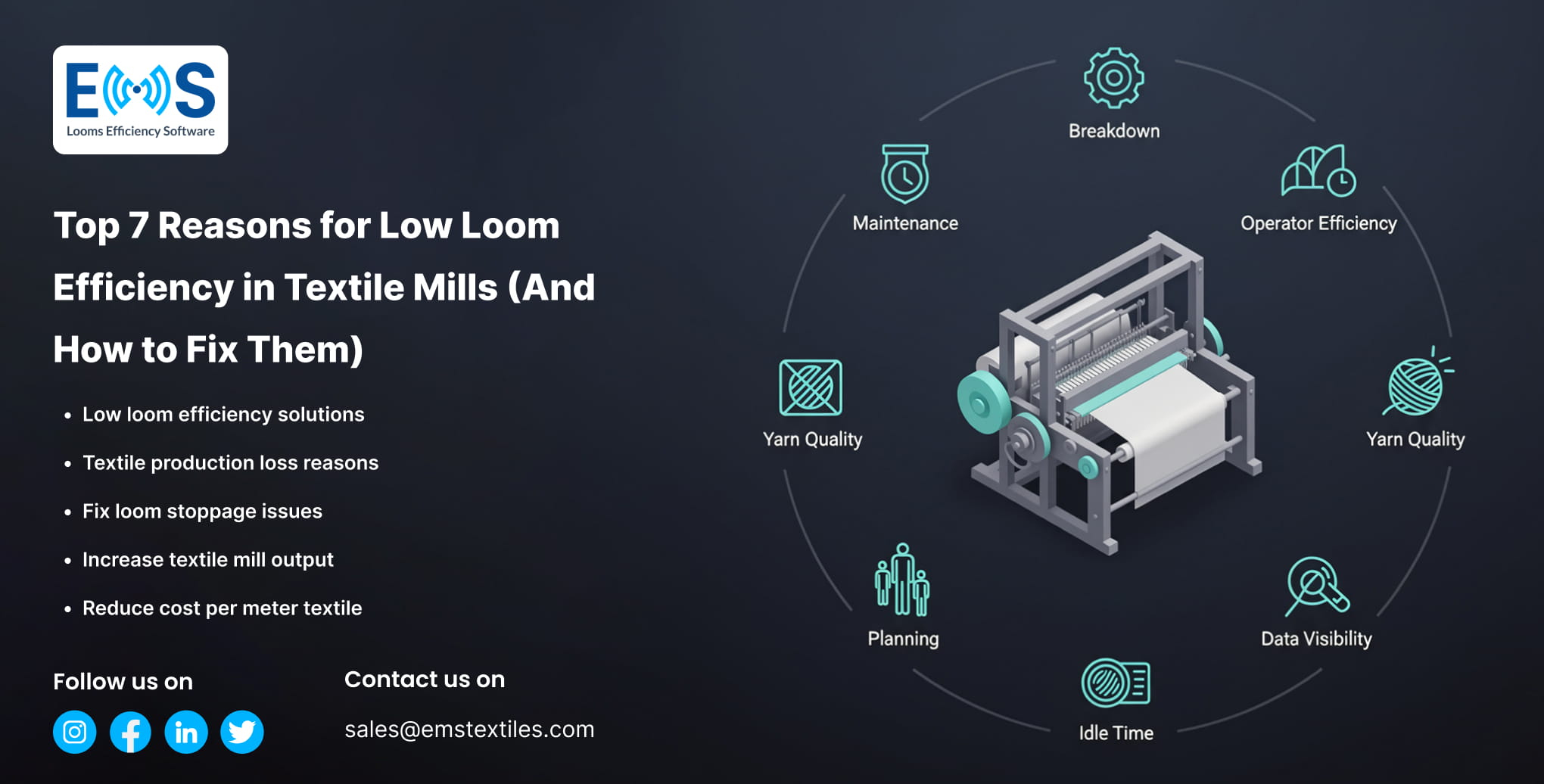
Top 7 Reasons for Low Loom Efficiency in Textile Mills (And How to Fix Them)
In weaving mills across the country, loom efficiency is often seen as just another number on a daily report. But if you’ve ever managed a textile mill, you know it’s far more than that – it’s the heartbeat of your operation. Loom efficiency shapes everything: your production output, your cost per meter, how quickly you deliver orders, and ultimately, your profitability.
Imagine this: your efficiency drops from 85% to 70%. At first glance, it might seem like a small dip. But over a full month, that “small” drop can translate into massive production losses, higher costs, and missed delivery deadlines. Suddenly, your team is scrambling to catch up, expenses start creeping upward, and customers are left waiting.
Many mill owners try to tackle this by looking only at machine downtime. It’s a logical place to start, but loom efficiency is actually influenced by much more – your machines, your people, your materials, and your management systems all play a part.
That’s why in this blog, we’re not just listing the usual suspects. We’ll dig into the real, day-to-day reasons why loom efficiency takes a hit in textile mills and, more importantly, share practical steps you can take to fix them. Whether you’re on the factory floor or leading a team, these insights can help you turn efficiency from a statistic into a competitive advantage.
Why Loom Efficiency Matters for Textile Mills
Loom efficiency directly affects your:
- Production output
- Cost per meter
- Delivery timelines
- Profit margins
Even a small drop from 85% to 70% can cause massive losses over time. That’s why smart mill owners focus on both machine and human factors to improve efficiency.
Top 7 Causes of Low Loom Efficiency (and Solutions)
1. Frequent Loom Breakdowns
Every weaver knows the frustration of a loom that keeps stopping – whether it’s a broken warp, a weft issue, or a sudden mechanical or electrical fault. Even minor stoppages, if they happen again and again, can drag your efficiency down before you realise it.
How to fix it:
- Follow a regular maintenance schedule – don’t wait for breakdowns.
- Track breakdown history for each loom to spot recurring issues.
- Replace worn-out parts before they cause a stoppage.
- Use a real-time loom monitoring system to catch problems as soon as they happen.
Many mills that monitor breakdowns in real time see their efficiency increase by 10–15%.
Even minor stoppages, if they happen again and again, can drag your efficiency down before you realise it.
Loom downtime is one of the biggest contributors to low efficiency. To understand its real business impact, read our guide on the hidden costs of loom downtime in textile mills.
2. Poor Preventive Maintenance Planning
It’s all too common in mills: machines are only fixed when they break down. This “wait until it fails” approach might seem easier in the short term, but it always ends up costing more – longer downtime, surprise breakdowns, and expensive emergency repairs. Even the best machines can’t perform well without regular care.
How to fix it:
- Set up a weekly and monthly maintenance checklist so nothing gets missed.
- Make sure everyone knows who’s responsible for each task.
- Check regularly that maintenance is actually being done, not just noted.
- Switch from paper registers to digital tools for better tracking and fewer mistakes.
Preventive maintenance doesn’t cost much, but it can make a huge difference to your mill’s performance.
If you’re not sure where to start, refer to this preventive maintenance checklist for weaving machines to structure your process.
3. Low Operator Efficiency
No matter how modern your looms are, it’s your operators who keep the mill running smoothly. If they aren’t quick to respond to stoppages, aren’t handling yarn correctly, or are stretched too thin, you’ll see more idle time and less output. Sometimes, it simply comes down to a lack of training or clear expectations.
How to fix it:
- Make regular operator training a priority.
- Track efficiency for each operator to spot where support is needed.
- Set clear, fair performance goals.
- Use monitoring systems to see how quickly operators respond to problems.
Mills that invest in their operators through training and monitoring often boost efficiency quickly, without spending extra on new machines.
4. Poor Yarn Quality
Even the best looms can’t make up for poor yarn. If the yarn is uneven, weak, or full of contaminants, you’ll face constant thread breaks and unexpected stoppages. It’s a headache that adds up fast and quietly eats into your efficiency.
How to fix it:
- Choose yarn suppliers you trust for consistent quality.
- Check every new yarn batch before it goes to the looms.
- Keep records to see which yarn lots are causing trouble.
- Store yarn properly to prevent damage or contamination.
Many mills overlook material quality, but it has a direct and powerful effect on your machine efficiency.
5. Inefficient Production Planning
When production isn’t well planned, you end up with frequent style changes, looms sitting idle during setups, and some machines overloaded while others hardly run. All of this chips away at your overall efficiency.
How to fix it:
- Fine-tune your production schedule to minimize disruptions.
- Cut down on unnecessary style or design changes.
- Group similar orders so machines run longer without changeovers.
- Plan shifts carefully to keep workloads balanced.
Smart planning alone can boost efficiency – no need to invest in new machines or extra staff.
6. Lack of Real-Time Production Visibility
If you’re still relying on manual logbooks, end-of-shift reports, or Excel sheets, you’re always looking at yesterday’s problems. By the time you spot an issue, the damage is already done. Without real-time data, it’s almost impossible to react quickly or truly understand how your machines are performing.
How to fix it:
- Invest in a real-time loom monitoring system (EMS) for instant updates.
- Track production, downtime, and efficiency as they happen – not hours later.
- Set up alerts, so you know the moment a machine stops.
- Use dashboards to make faster, better decisions.
Real-time data lets you shift from always reacting to problems to proactively managing your mill for better results.
If you’re still unsure whether to switch, here’s a detailed comparison of loom monitoring systems vs manual tracking and which is more cost-effective for textile mills.
7. High Idle Time Between Jobs
One of the easiest things to overlook is the wasted time between orders – waiting for instructions, hunting for materials, or setting up for the next style. Even a few minutes lost here and there can add up to a big hit on your efficiency over time.
How to fix it:
- Standardize and streamline your setup processes so everyone knows what to do next.
- Make sure raw materials are ready before the job changes begin.
- Improve communication and coordination between departments so nothing gets held up.
- Use monitoring systems to measure and reduce idle time.
Cutting down on idle time is a simple way to boost efficiency – without making your team work harder.
Why Loom Efficiency Matters More Than You Think
Loom efficiency isn’t just a production number – it touches every part of your business. When efficiency drops, costs per meter go up, profit margins shrink, deliveries get delayed, customers get frustrated, and the stress on your team rises. But the good news? Even a small bump in efficiency of just 5–10% can mean more output without buying new machines, stronger profits, and a real edge over the competition.
The Power of Loom Monitoring Systems (EMS)
That’s why so many top mills are moving to digital production monitoring. With a good Monitoring System like EMS – you’re not left guessing. You see your loom efficiency live, know exactly why downtime happens, keep track of operator performance, and spot problems right away. Real-time data means you make faster, smarter decisions – no more running on assumptions.
Final Thoughts
Low loom efficiency is rarely caused by just one thing. It’s often a mix of machine hiccups, operator habits, planning mishaps, and lack of visibility. The key is to dig into what’s really happening on your shop floor and start fixing issues, one step at a time.
Start small:
- Find out what your true efficiency is right now
- Pinpoint where the biggest losses are happening
- Focus on solving one problem before moving to the next
If you want to see steady, reliable improvement, a real-time loom monitoring system can be a game-changer.
Ready to Boost Your Loom Efficiency?
If your goal is to increase production, cut downtime, and finally see what’s happening in your factory as it happens, we’re here for you. We help textile mills unlock better efficiency and bigger profits with advanced loom monitoring solutions.
Reach out for a free demo, and let’s show you how real-time data can transform your mill’s performance.